


ZEITWORKS
"Code 265" 930 Turbo Laptop - Mackenzie Tartan
"Code 265" 930 Turbo Laptop - Mackenzie Tartan
Couldn't load pickup availability
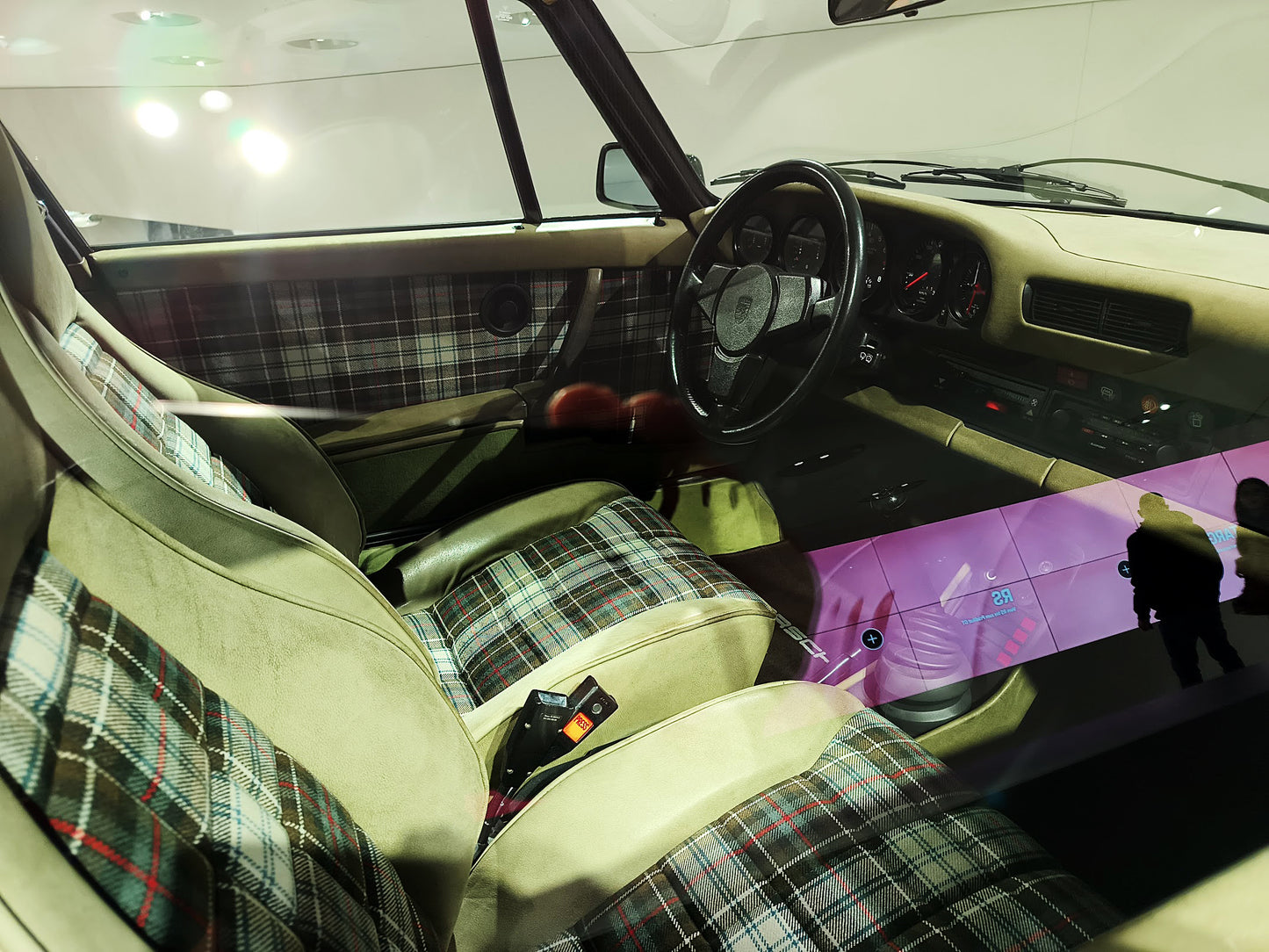
The Mackenzie tartan Anatole Lapine designed for Ferry Porsche's personal 1976 911 Turbo — Oak Green Metallic, Code 265. The "Ferry Porsche Spec," never reissued by the factory.
By 1976, the Porsche 911 Turbo (930) had evolved into its iconic "wide-body" production form. When Ferry Porsche commissioned his personal 3.0L Turbo, he specified it in Oak Green Metallic (Code 265). To complement the exterior, chief designer Anatole Lapine’s team outfitted the interior with a highly specific, earthy tartan. Today, this configuration is legendary among purists as the "Ferry Porsche Spec."
This piece utilizes new-production, historically accurate Mackenzie Tartan, capturing the exact 1976 factory palette of forest green, navy, beige, and white/red striping used in Ferry Porsche's personal car.
* Compartment for the laptop
* Zippered interior and exterior pocket
* 4 internal open accessory pockets
* Adjustable and detachable shoulder strap
* Handle to carry the bag easily
* Size: 38cm x 27 x 10 (15" x 10 1/2 x 3 1/2)
Each ZEITWORKS bag is a unique creation, carrying the history and character of the car of the vehicle it once belonged to, making every design impossible to replicate.
Handmade in Canada
A Note on Brand Transparency: ZEITWORKS is an independent design company passionate about automotive history. We source and upcycle authentic vintage materials, but we are not affiliated with, authorized, maintained, sponsored, or endorsed by Dr. Ing. h.c. F. Porsche AG, Mercedes-Benz Group AG, Bayerische Motoren Werke AG (BMW), General Motors LLC (including Cadillac), or any other original automotive manufacturers. Our products are independent creations made to celebrate the legacy of these iconic designs.


Questions
What is this piece made from?
Every ZEITWORKS piece is made from the original interior of a specific vintage car, or from authorised reproductions of period factory textiles. Each piece is cut and assembled by hand in our studio in Snow Road Station, Ontario.
Is each piece unique?
Heritage pieces are one-of-one — built from the original interior of a single car. When that material is finished, no second piece exists. Signature pieces are made in small batches from authorised reproductions of factory textiles.
Can the piece be repaired or restored?
Yes. We have worked with leather and automotive textiles for nearly twenty years and can advise on care, repair, and restoration. Write to info@zeitworks.ca.
How does shipping and returns work?
Orders are processed within 72 hours and shipped from our Ontario studio. Returns are accepted within 72 hours of receipt, in original condition. Sale items and custom pieces are final sale.
About the Tartan
factory option · Porsche 930 Turbo era · ca. 1976-1989 · woven wool · period color: black, beige, brown, red ground
Mackenzie was one of two factory tartan patterns Porsche offered through the 930 Turbo years — the other being McLaughlan. Both were woven from heavy wool to a specification Porsche developed in the late 1970s in collaboration with European textile mills, and both were paired with full leather on the bolsters and headrests. The pattern was based on the traditional Scottish Mackenzie sett, with its characteristic green and blue ground crossed by red and white over-checks, but the Porsche version was rebalanced for use in a sports car cabin.
The tartans arrived at a moment when Porsche was building, simultaneously, the most aggressively turbocharged road car of the 1970s and the most quietly distinctive interior textile programme in the industry. The 930 Turbo was the supercar of the cocaine era — Don Johnson drove one through Miami Vice, Doc Brown drove one in Back to the Future Part II's alternate 1985 — and the cabin's tartan inserts became the unofficial visual marker of Porsche's most confident decade.
The pattern was discontinued with the end of the 930 in 1989 and never reissued. Surviving original-fitment Mackenzie tartan from the period is now an extremely small remaining stock, and the textile is increasingly recognized by Porsche restorers as the single most distinctive material the factory ever specified.